Lunenburg County Mesh is built around a simple idea: many small, shared relay points working together instead of one large central tower; using the open source Meshcore system.
This approach creates a resilient, local communications network that continues working even when cellular service or the internet is unavailable.
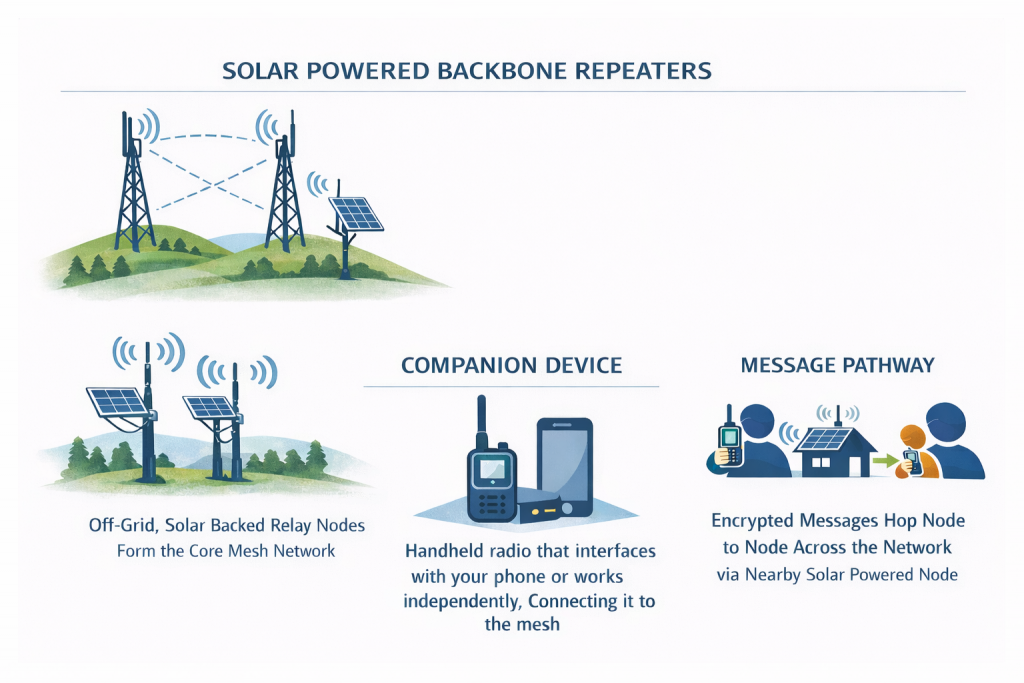
Solar-Powered Backbone Repeaters
Backbone repeaters are fixed radios installed outdoors at elevated locations. They are powered by solar panels and batteries and are designed to operate continuously.
These repeaters form the core infrastructure of the network. Each repeater receives messages and forwards them to other repeaters, allowing communication to travel across long distances.
Companion Devices
Companion devices are personal or portable devices used by individuals to send and receive messages over the network.
They connect to nearby backbone repeaters rather than maintaining the network themselves. Companion devices may interface with a phone or operate as standalone devices, and they are not required to be always on.
Message Hopping
Messages do not travel in a single jump. Instead, they move step by step from one backbone repeater to the next.
This process—called message hopping—allows the network to cover large areas reliably. If one repeater goes offline, messages can often find another path.
Why This Works Well in Lunenburg County
- Natural elevation and ridge lines
- Rural gaps and coastal dead zones
- Frequent power outages during storms
- Solar-powered nodes that can remain online for extended periods
What This Network Is Not
This network is not a replacement for emergency services and does not provide internet access. It is a local, community-built communications layer designed to increase resilience and coordination.